Heat
Between Fire and Ice: Order, Chaos, and the Symbiotic Duality of Vincent Hanna and Neil McCauley in Heat
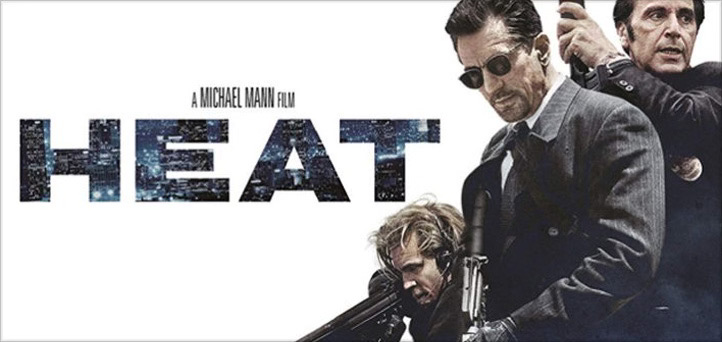
Michael Mann’s Heat (1995) is not merely a seminal entry in the crime genre; it is a sweeping, existential meditation on duality—on the interplay between structure and entropy, personal code and moral decay, law and lawlessness. Its narrative of cops and robbers is elevated beyond conventional tropes by the philosophical weight of its characters and the precision of its cinematic craftsmanship. While on the surface, Heat presents itself as a sprawling Los Angeles crime epic centred around a meticulous bank heist and the detective seeking to thwart it, the film’s real engine is the psychological and moral entanglement between its two leads: LAPD robbery-homicide detective Vincent Hanna (Al Pacino) and professional thief Neil McCauley (Robert De Niro). These two men—at—once antagonists and reflections are constructed not as opposites, but as dual aspects of the same existential condition.
From the opening sequences, Mann invites the viewer to see Hanna and McCauley not as hero and villain, but as equals walking parallel paths. The film focuses less on the logistics of crime and more on the personal philosophies that govern its characters’ lives. Through its pacing, tone, mise-en-scène, and character development, Heat constructs a complex dialectic between chaos and control, where each man must constantly confront the costs of his chosen way of life.
This essay will investigate how Heat explores the duality of order and chaos through the evolving relationship between Hanna and McCauley, revealing that their lives are governed by rigid codes, ultimately leading to their undoing. Through narrative symmetry, visual metaphor, and emotional resonance, Mann constructs a tragic symphony wherein opposites' interplay becomes inevitable and fatal.
I. The Architecture of Duality: Narrative Symmetry and Cinematic Form
Mann’s commitment to duality is not merely thematic but structural. Heat is meticulously designed to mirror its central characters across every axis—plot, visuals, tone, and ideology. The film begins with sequences that subtly establish this symmetry: Neil McCauley and his crew carry out a violent armoured car heist with military-like precision, while Vincent Hanna, introduced through his work investigating the aftermath, reveals a similarly obsessive approach to law enforcement. Both men are methodical, commanding, and surrounded by a loyal crew. They are professionals in every sense—a term Mann often uses in his interviews to signify characters with a personal code.
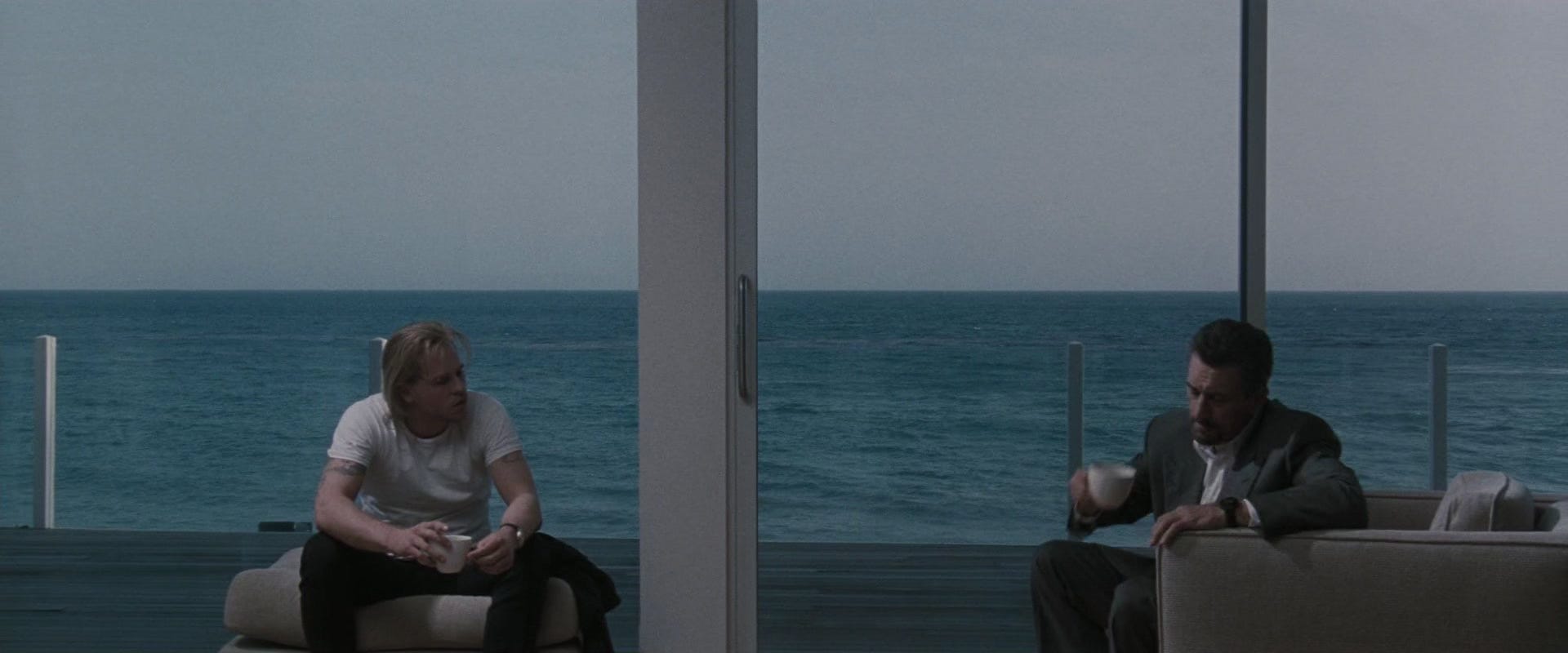
This structural mirroring continues throughout the film. Hanna and McCauley are both defined by their work and are shown to struggle with the personal consequences of their single-minded pursuit of excellence. Hanna’s third marriage is crumbling, his teenage stepdaughter is emotionally unstable, and his relationship with his wife, Justine (Diane Venora), is strained by emotional distance. McCauley, meanwhile, lives alone in a sparse, impersonal house with a panoramic view of the ocean— a minimalist sanctuary devoid of warmth. He surrounds himself with equally closed-off men, living by a code that forbids personal attachments: “Don’t let yourself get attached to anything you are not willing to walk out on in thirty seconds flat if you feel the heat around the corner.”
Yet even as these characters differ in temperament—Hanna’s volatility contrasts with McCauley’s restraint—the film consistently highlights their spiritual and existential similarities. This duality is most explicitly articulated in the famed diner scene, where the two sit face-to-face and discuss their lives with disarming candour. They acknowledge the likelihood of a deadly confrontation, but also recognise something profound in one another. Their mutual respect is born not from opposition but from identification. As Hanna says, “I don’t know how to do anything else. I don’t much want to, either.” McCauley replies with the same line, creating a moment of mirrored fatalism.
Cinematographically, this symmetry is further emphasised by Dante Spinotti’s lensing. The film employs the wide, horizontal frame of anamorphic 35mm to capture the Los Angeles cityscape not merely as a backdrop, but as a reflective environment. Both Hanna and McCauley are frequently framed in long shots—isolated figures dwarfed by architecture, overpasses, and concrete expanses. This visual approach underscores their loneliness and disconnection from human interaction. McCauley’s ocean-view apartment, depicted in cool blues and steel greys, becomes a visual representation of his internal detachment. In contrast, Hanna’s cluttered home reflects chaos and emotional disorder, even as he clings to the order of his professional life.
The film’s editing and sound design enhance this dialectical approach. Mann frequently employs crosscutting to juxtapose the actions of Hanna and McCauley, emphasising how their decisions resonate with one another. When McCauley surveils a target, the camera cuts to Hanna doing the same. When McCauley finds momentary solace in a romantic relationship with Eady (Amy Brenneman), Hanna attempts a reconciliation with Justine. The parallel editing does not imply causality but rather resonance—a shared rhythm between two men caught in a mutual dance of compulsion and contradiction.
Elliot Goldenthal’s ambient score enhances this structure by creating emotional continuity across disparate scenes. The music often flows without a clear melody, relying on tonal shifts and layered textures to evoke an atmosphere of tension and melancholy. It serves as a sonic reflection of the film’s emotional state: always teetering between quiet control and explosive release. Particularly in scenes where characters drive through the empty night or gaze out at the urban sprawl, the score operates like an internal monologue—abstract, searching, unresolved.
Furthermore, the genre construction of Heat plays into this dualistic framework. It is not a film with a clear moral binary. Unlike traditional crime dramas where the police officer represents absolute good and the criminal embodies evil, Heat destabilises these archetypes. Hanna is brash, unstable, and emotionally unavailable, while McCauley is thoughtful, composed, and loyal to his team. Neither is glamorised nor vilified. Instead, each is depicted as a man who has shaped his life around a guiding principle—order through law for Hanna, order through discipline for McCauley. Yet both orders are fragile, susceptible to human weakness, love, revenge, and the gravitational pull of entropy.
Film scholar Robert Kolker, in his analysis of Mann’s oeuvre, writes: “Mann is less interested in morality than in behaviour; his films don’t ask who is right, but what it costs to remain who you are.” In Heat, the response is stark: to remain who they are, both Hanna and McCauley must accept isolation, suffering, and loss. Their duality is not a philosophical game—it is a death sentence.
II. Vincent Hanna: Chaos Wielded in Service of Justice
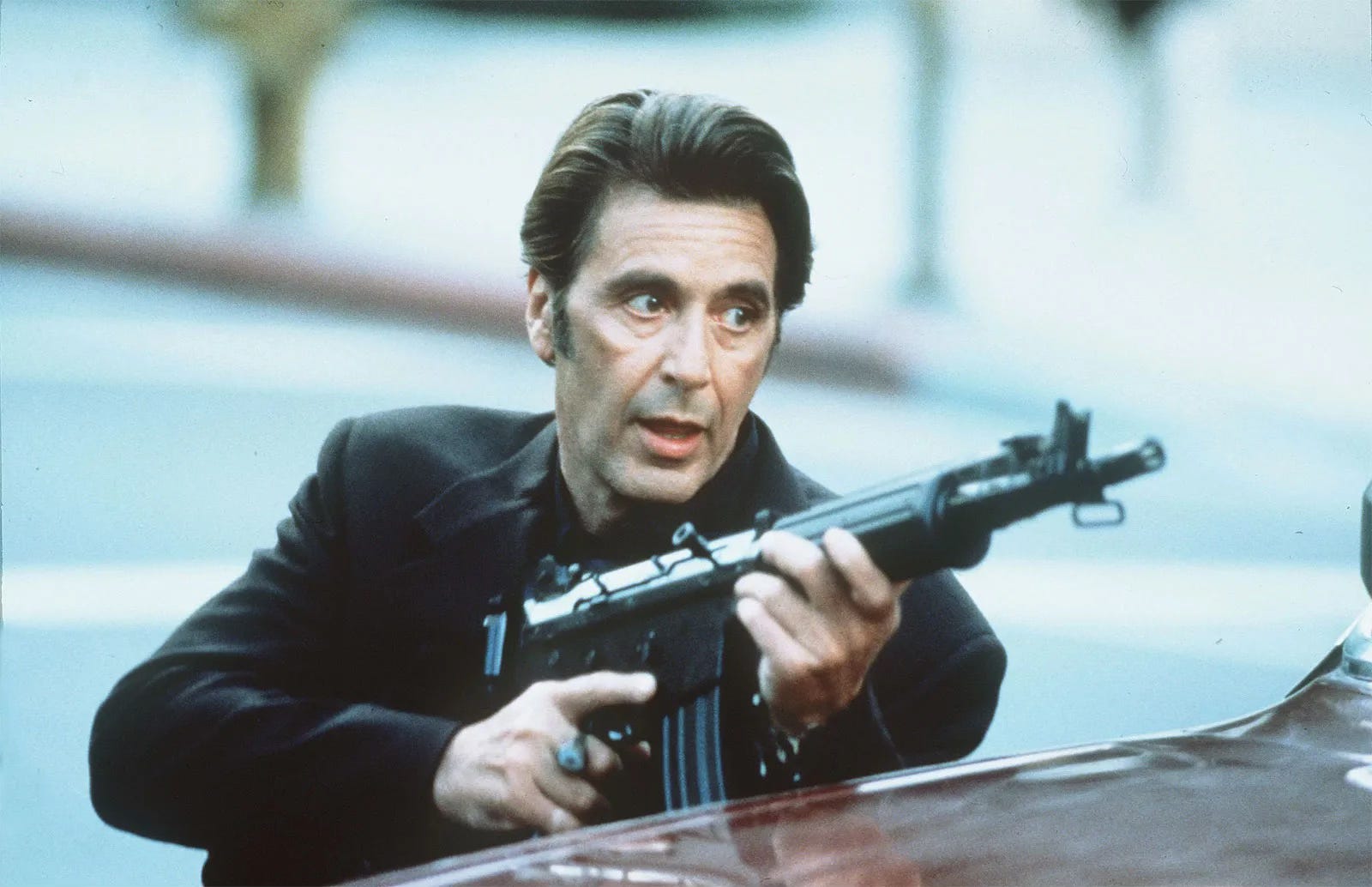
Vincent Hanna, portrayed by Al Pacino at his most operatic, is one of Michael Mann’s most fascinating studies in contradiction. He is a figure of immense charisma and intensity, whose frenetic energy conceals an internal disorder. Unlike the calm and collected Neil McCauley, Hanna operates in a state of constant motion—his body language, speech patterns, and investigative methods are all infused with kinetic urgency. Hanna represents the last line of defence in a world of escalating crime and moral erosion, but his version of order is founded upon a roiling undercurrent of chaos.
Mann constructs Hanna not as a righteous lawman, but as a man whose obsession with justice approaches self-destruction. He does not pursue criminals out of a civic sense of duty; rather, as he confesses, he’s drawn to it. “I’m chasing guys like you,” he tells McCauley, “because if I’m not, I’m nothing.” This admission reveals the existential void at the core of Hanna’s identity. He is defined not by his detective role but by his adversaries. Crime provides him with meaning, and the quest for control over chaos is less a mission than a compulsion. This aligns with Mann’s recurring motif throughout his filmography: the protagonist who is consumed by the thing at which he excels.
Pacino’s performance pushes the boundaries of naturalism into theatricality, characterised by his sudden outbursts and volatile energy. He is often depicted shouting, interrogating, and commanding space with a manic fervour that borders on instability. Yet this isn’t mere overacting—it is the embodiment of Hanna’s internal disarray. Unlike McCauley, who retreats into silence and solitude, Hanna externalises his chaos, wielding it as a weapon against the disorder he encounters on the streets.
This instability seeps into his personal life. His third marriage to Justine is unravelling, and we witness their domestic scenes filled with passive-aggressive exchanges and mutual alienation. Hanna’s chaotic professional life bleeds into his home; he cannot turn off the part of himself that thrives on intensity. Justine offers one of the film’s most poignant lines when she tells him, “You don’t live with me. You live among the remains of dead people.” This encapsulates Hanna’s relationship not just with her, but with life itself. He is always elsewhere, emotionally unavailable, and mentally entangled in the brutality he encounters daily. His role as a husband and stepfather is nominal; he shows compassion for Lauren (Natalie Portman), but he lacks the tools for intimacy or nurturing.
Mann deliberately blurs the line between Hanna’s pursuit of justice and personal chaos. In a genre typically predicated on clear moral delineation, Heat presents us with a scarcely more stable detective than the men he hunts. Hanna doesn’t embody the triumph of order—he embodies the volatility of attempting to impose it in an increasingly disordered world. His tactical brilliance, relentless dedication, and success as a cop all come at the expense of his emotional life. As we witness his unravelling marriage, his hollow attempts at connection, and his manic disposition, it becomes clear that Hanna personifies chaos just as much as the criminals he pursues. The only difference is that his chaos is sublimated into the apparatus of law.
His relationship with violence is similarly paradoxical. Though ostensibly a figure of authority, Hanna’s reactions to violence often carry a personal thrill. During the legendary bank heist shootout, he is completely in his element. While civilians run for cover and bullets fly through the streets of Los Angeles, Hanna moves with purpose and exhilaration. The chaos of the moment reflects the internal turmoil he harbours within himself. In the aftermath, when McCauley escapes and several of his own men are killed, Hanna appears more enlivened than devastated. Death and disorder sharpen him. In these moments, his identity feels most solidified.
This raises a crucial question Mann weaves throughout Heat: is Hanna fighting chaos, or is he drawn to it because it reflects himself? His pursuit of McCauley becomes less about justice and more about the allure of the chase. The diner scene crystallises this: two men sitting across from each other, understanding that they will try to destroy one another, yet recognising a rare kinship in each other. Hanna doesn’t merely acknowledge McCauley as a worthy adversary—he sees him as a necessary one. Without McCauley, Hanna would be untethered, his professional identity dissolved. Mann’s point here is subtle but profound: sometimes chaos and order need each other to survive.
Hanna’s volatility serves as a counterpoint to McCauley’s control. While McCauley is stoic, quiet, and calculating, Hanna is explosive, intuitive, and often improvisational. In scenes where he interviews informants, such as the sleazy Albert Torena, Pacino’s Hanna oscillates between psychological manipulation and raw intimidation. He does not adhere to protocol—he follows instinct. This imparts to him an unpredictability, a trait that reflects the very criminals he targets. Once again, the boundary between order and chaos is not a line—it is a membrane. Hanna does not merely cross it; he inhabits both sides.
Moreover, Hanna is not immune to emotional vulnerability. After Lauren’s suicide attempt, we see him crack. He holds her, shaken, and something breaks inside him. It is a rare moment of tenderness in a character otherwise defined by drive and edge. Here, Mann allows us to see the human cost of Hanna’s lifestyle—not only for those around him, but for Hanna himself. He has built his life around principles that no longer sustain him. His code offers no protection against emotional collapse. This moment is not redemptive—it is tragic.
Vincent Hanna, then, is not the avatar of order he seems to be. He is chaos in uniform, a man whose professional identity provides a temporary scaffold for internal disarray. His personal life is in ruins, his psyche fraying, and his sense of self increasingly tethered to the man he is pursuing. In Mann’s vision, Hanna is both the guardian against entropy and its vessel. He embodies the impossibility of clean, dichotomous distinctions. His chaos is not the opposite of order—it is its byproduct.
III. Neil McCauley: Monastic Order in the Service of Crime
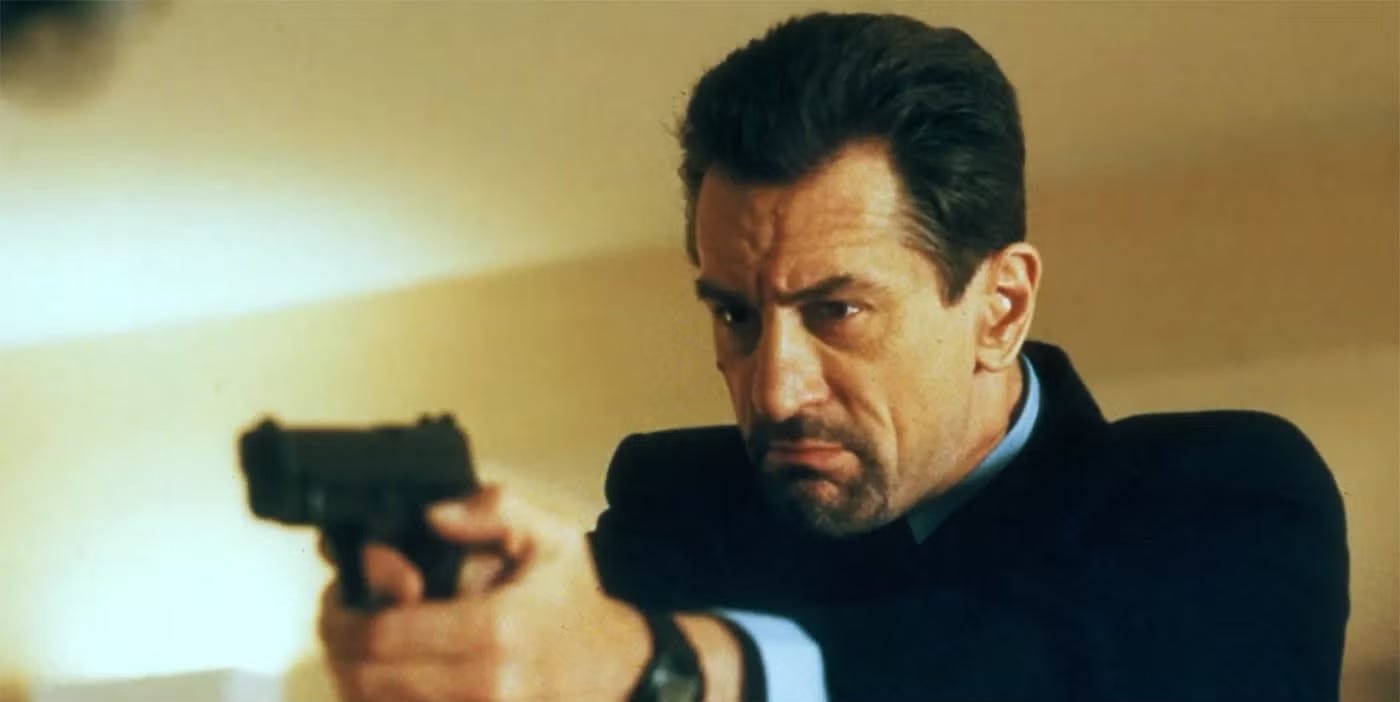
In stark contrast to Vincent Hanna’s restless volatility stands Neil McCauley, the quiet, disciplined thief who represents a radically different expression of control. While Hanna embodies chaos cloaked in the veneer of law, McCauley is the architect of criminal order—rigid, stoic, and obsessively methodical. Portrayed by Robert De Niro with surgical precision, McCauley is a man who has constructed his identity on detachment and principle. He is neither an anarchist nor an impulsive outlaw. Instead, he epitomises the professional criminal, whose life is governed by rules as strict as any code of law.
At the core of McCauley’s philosophy lies his maxim: “Don’t let yourself get attached to anything you are not willing to walk out on in thirty seconds flat if you feel the heat around the corner.” This mantra serves as both a tactical guideline and a personal creed. For McCauley, discipline is not merely a means of evading capture—it is a way of shielding himself from vulnerability. In the moral geometry of Heat, McCauley is not chaotic but hyper-ordered. Every action is deliberate, every step rehearsed. He manages his crew like a military unit, emphasising loyalty, efficiency, and professionalism. His heists are not crimes of desperation but of design, crafted with an artisan’s attention to detail.
Mann constructs McCauley as an ascetic figure, nearly monastic in his solitude. He resides in a minimalist home devoid of personal décor, emotional attachments, and superfluous possessions. His ocean-view apartment serves as a liminal space—neither a home nor a hideout, but a place of in-betweenness. In the film's visual language, this space reflects McCauley’s detachment from society. He stands at the edge of the continent, with the Pacific Ocean stretching infinitely before him—a symbol of freedom, yet also emptiness. The cold blues and greys that dominate these scenes, captured in Dante Spinotti’s crisp cinematography, echo McCauley’s emotional isolation.
De Niro’s performance is characterised by restraint. His McCauley rarely raises his voice and seldom emotes. Every gesture is small yet deliberate. His minimalism is not merely aesthetic but ontological; he has stripped his life down to what he believes are its essentials: the job, the code, and survival. Yet within this rigidity lies a profound vulnerability. McCauley’s need for control is a defensive posture, a means of keeping the chaos of the world at bay. His emotional austerity is not a sign of strength but of fear—fear of loss, of attachment, of unpredictability.
This internal contradiction becomes most evident in his relationship with Eady. Their romance is one of the most humanising threads in the film. When McCauley first encounters her at a diner, he is cautious, distant, and uneasy with the idea of connection. Yet, as their relationship progresses, a subtle shift becomes clear. McCauley begins to long for something beyond his solitary code. He talks about a future in New Zealand, escaping the life of crime, and disappearing into anonymity. These dreams signify the emergence of desire—the one thing his philosophy cannot accommodate. By falling for Eady, McCauley violates his own principle. He begins to form attachments.
This shift reveals the central irony of McCauley’s order: it is ultimately unsustainable because it denies the human need for connection. His code, designed to protect him, becomes a prison. Mann presents this not as a failure of criminality but as a failure of absolutism. No life, no matter how disciplined, can remain untouched by emotional gravity. McCauley’s pursuit of freedom through control leads him to the precipice of transformation—yet it is this very pursuit that also condemns him.
The breakdown of McCauley’s discipline is gradual yet significant. The key turning point occurs when he decides to seek revenge on Waingro, the rogue member of his crew who betrayed him. In opting for vengeance over escape, McCauley undermines the very principle that has defined his existence. He feels the pressure, but instead of walking away, he turns back. This moment serves not only as a plot pivot but also as a thematic rupture. McCauley’s order, once impeccable, has been tainted by emotion, pride, and the need for closure. He becomes, in effect, more human—and thus more fallible.
Mann treats this fall not with judgment but with tragic reverence. McCauley is not punished for being a criminal; he is undone by the very human impulses he sought to suppress. In this way, Heat becomes a kind of Greek tragedy, where the protagonist’s downfall stems not from external forces but from an internal contradiction. The closer McCauley comes to freedom—both literal and emotional—the more his carefully maintained control begins to fracture. His love for Eady and his desire for vengeance represent the incursion of chaos into a life founded on logic. He violates his own rules, and the consequences are fatal.
Yet even in his final moments, McCauley maintains a degree of clarity. When Hanna finally corners him at LAX, the two do not engage in a grand standoff. Instead, McCauley runs, calculated and precise, even in desperation. As Hanna fatally shoots him, McCauley reaches out for a hand, not in aggression, but in recognition. The final image of the film—Hanna holding McCauley’s hand as he dies—is among the most emotionally resonant in Mann’s oeuvre. It is not a victory, but a benediction—the cop and the criminal, united at last, not in ideology but in understanding.
McCauley’s death marks the logical conclusion of his arc, yet it is not depicted as moral retribution. Instead, it arises inevitably from the attempt to impose order on a fundamentally disordered world. Mann provides no easy answers—no didactic message regarding crime not paying, no glorification of the law. Rather, he portrays McCauley as a tragic figure, undone not by greed or corruption, but by the human need for connection that his code could not endure.
Thus, Neil McCauley embodies a different kind of chaos—one that arises from within order. His life is a fortress constructed on precision, yet all fortresses are susceptible to cracks. His downfall exemplifies the limits of control and the futility of attempting to live devoid of the consequences of emotions. McCauley is not vanquished by Hanna, but by himself—by the contradictions of a life devoted to outwitting entropy.
IV. The Diner Scene: A Dialogue of Duality
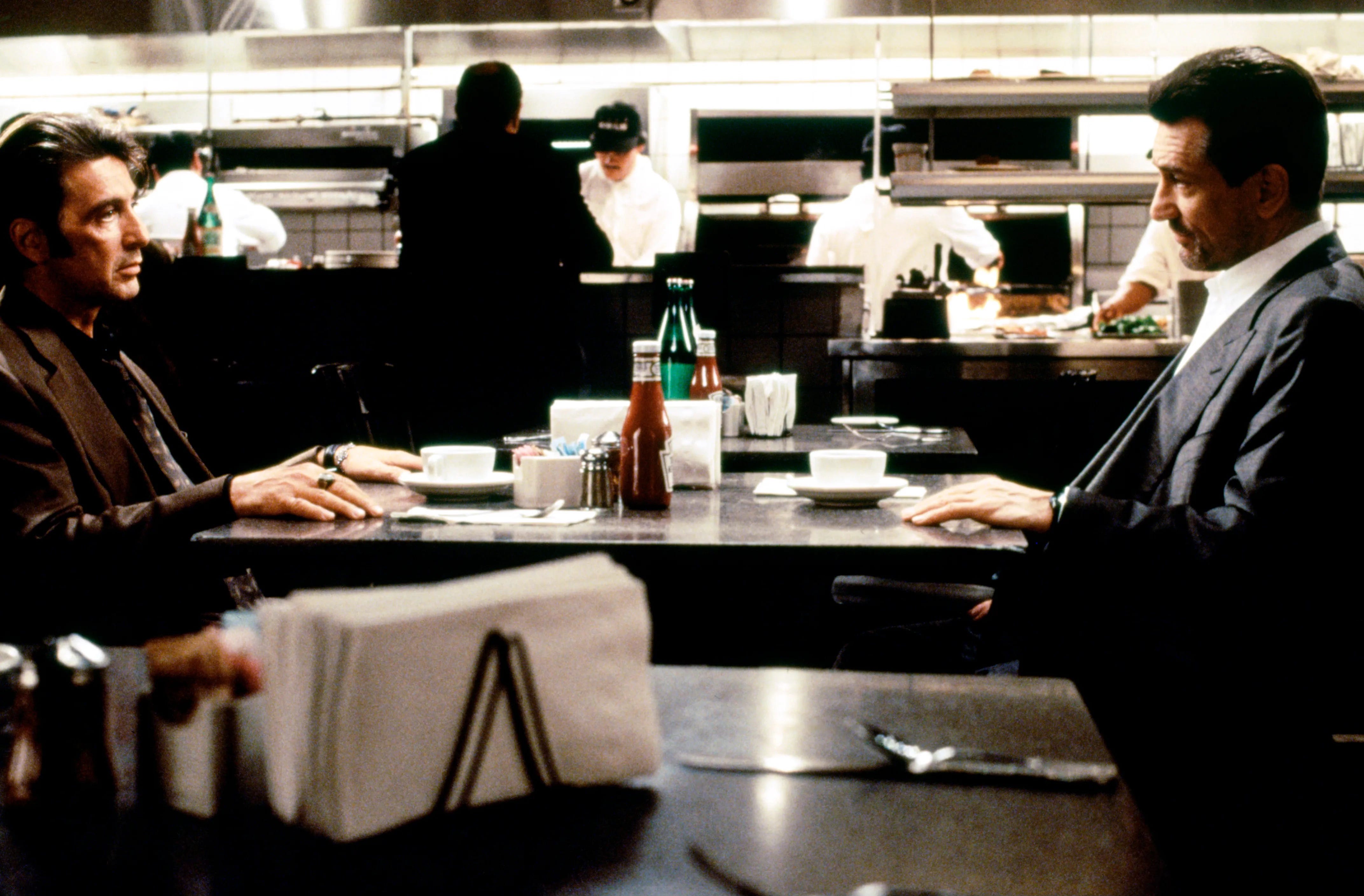
Suppose Heat is a meditation on the tension between order and chaos. In that case, its most emblematic moment arrives not during a gunfight or a heist, but in the quietude of a conversation. The now-legendary diner scene between Vincent Hanna and Neil McCauley serves as the film’s emotional and philosophical axis. Shot with spare elegance by Michael Mann and filmed with two cameras—one on De Niro, one on Pacino—the scene avoids flashy editing or stylised lighting, opting instead for realism and restraint. In its simplicity, it allows two titanic performances to unfold uninterrupted. More importantly, the scene crystallises the film’s central preoccupation with duality.
This moment is remarkable not merely for its novelty—two adversaries breaking bread—but for how it deconstructs the dichotomy between criminal and cop. Hanna and McCauley, though ostensibly on opposite sides of the law, share an intimate understanding of one another. They are not mirrors in a clichéd sense, but rather two men who have navigated the same existential terrain and arrived at opposing conclusions. Both are consumed by their professions, isolated by their choices, and defined by a sense of inevitability. Their conversation is more about communion than confrontation. They speak not as enemies, but as fellow travellers.
The scene begins with mutual respect. Hanna initiates the meeting, having followed McCauley for days, but he does not threaten or belittle him. He offers coffee. There is a sense that both men are weary of the façade of pretending they are anything other than what they truly are. “You do what you do,” Hanna says. “I do what I gotta do.” This formulation strips away moral pretensions. Mann isn’t interested in presenting one as right and the other as wrong. He is interested in the forces that drive men to the edges of society, and how they rationalise their lives on those edges.
What follows is a dialogue that oscillates between personal revelation and existential reflection. McCauley speaks of his discipline and the clarity that arises from eliminating attachment. “If you’re not ready to walk out on anything in 30 seconds flat,” he says, “then you’ve got a problem.” Hanna counters with his compulsions, describing the violence he’s witnessed and the toll it has taken on him. “I have to hold on to my angst,” he says, “I preserve it, because I need it.” Each man has shaped his identity around a central belief—McCauley through detachment, Hanna through intensity. Yet both acknowledge the cost of these beliefs. Both understand that their methods have left them alone.
One of the most powerful aspects of the diner scene is how Mann uses it to question the illusion of difference. The cop and the criminal are meant to be opposites, yet the conversation reveals their alignment. Both are exceptional at what they do, the consequences haunt both, and their codes entrap both. They represent two expressions of the same existential dilemma: how to impose meaning on a world defined by entropy.
The structure of the dialogue further reinforces this mirroring. They engage in alternation rather than interruption. There are no raised voices, no accusations, no moral posturing. Instead, there is an eerie calm—a mutual recognition that they are bound together. “I don’t know how to do anything else,” McCauley says. “Neither do I,” Hanna replies. “And I don’t much want to, either.” This moment of unison is devastating. It exposes the hollow space beneath their respective identities. They are not just doing what they’re good at—they are doing the only thing they can. Their professions are both a calling and a curse.
Importantly, the scene does not function as exposition or a plot device. It is not about strategy or manipulation. Nothing is resolved or advanced in the conventional sense. Instead, the diner scene serves as the film’s philosophical centrepiece, a Socratic exchange in which the participants are not trying to persuade, but to understand. It is a moment of clarity—perhaps the only one either man experiences in the film—where the noise of the world falls away, and two individuals confront the truths of their existence.
The scene’s power is amplified by its stillness. Mann, known for his kinetic energy and precise pacing, allows this moment to breathe. The camera holds steady, trusting the actors and the words. There is no soundtrack and no underscoring. The silence is thick with significance. Even the background hum of the diner fades into insignificance. What matters are the faces, the eyes, and the tonal shifts in voice. This is not merely dialogue—it is communion. Two men, stripped of artifice, speak in the language of those who have nothing left to prove.
The scene also serves as a prelude to the ending. By meeting face to face, Hanna and McCauley acknowledge the inevitability of their confrontation. However, they do so without animosity. There is no hatred between them, only inevitability. “If it’s between you and some poor bastard whose wife you’re gonna turn into a widow,” Hanna says, “you are going down.” And McCauley, without flinching, nods. He understands. He would do the same. In this moment, Mann explores a unique kind of honour, not one based on legality or righteousness, but on understanding one’s role in a larger, tragic machinery.
From a thematic standpoint, the diner scene encapsulates the film’s central paradox: that order and chaos are not binaries but interdependent forces. Hanna represents institutional order, yet his life is chaotic. McCauley embodies criminal chaos, yet his methods are ordered. Their conversation blurs the boundary, suggesting that neither man is wholly defined by his label. The labels may be the least important aspect of who they are.
The cultural significance of the diner scene cannot be overstated. It has become a touchstone in film history not only because it features two acting legends sharing the screen for the first time, but also because it elevates genre cinema to the level of existential inquiry. In a film filled with gunfights, chases, and tactical brilliance, the most memorable scene involves two men conversing. This exemplifies the genius of Heat. It employs the framework of a crime thriller to stage a philosophical duel, where words replace bullets, and the stakes are nothing less than the soul.
Ultimately, the diner scene is not a pause in the action—it is the action itself. It is the moment when everything comes into focus, where the boundaries between cop and criminal dissolve, leaving behind two men trying to navigate the ruins of their own making. It represents a moment of grace, rare and fleeting, where understanding surpasses violence, if only for an instant. In that moment, Mann suggests that even within chaos, there can be order, just as, within order, chaos patiently awaits.
V. The Bank Heist and Street Shootout: Chaos Unleashed
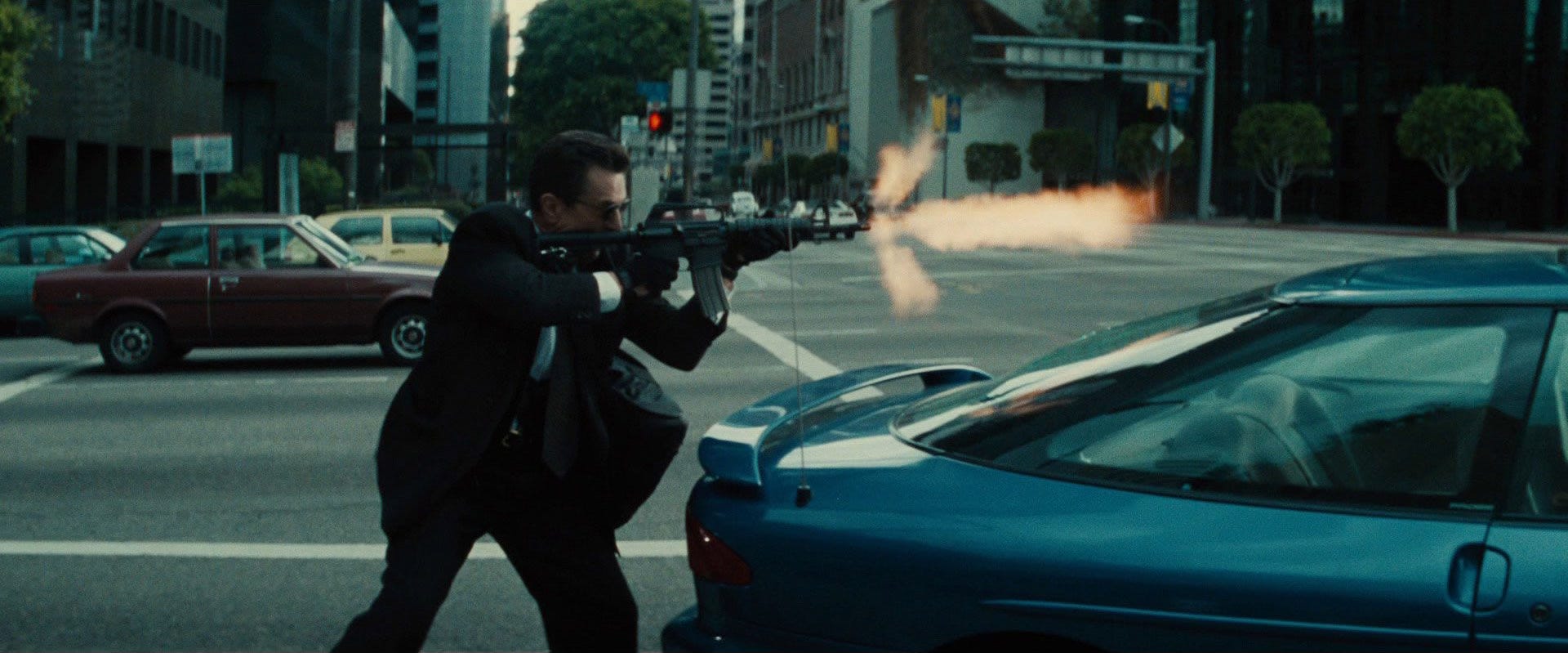
While Heat thrives on character nuance and psychological duality, it also delivers one of the most technically masterful and thematically charged action sequences in modern cinema. The bank heist, followed by the extended downtown shootout, is not merely a visceral set piece; it represents the crystallisation of the film’s underlying tension between order and chaos. It signifies the moment when control, so painstakingly maintained by both Vincent Hanna and Neil McCauley, ultimately gives way to an explosive rupture. Mann stages this sequence with military precision and documentary realism; yet, the true power of the scene lies in its thematic resonance. It is the moment when theory becomes consequence—when personal codes, however rigid, are tested in the fires of real-world unpredictability.
The heist itself begins with a sense of eerie calm. McCauley and his crew—Chris Shiherlis, Michael Cheritto, and Donald Breedan—move with synchronised efficiency. Their timing is flawless, and their execution seamless. The bank is subdued within minutes. Civilians are controlled but unharmed, and the transaction, from entry to escape, feels almost like a ballet of professional criminality. This initial sense of order reinforces McCauley’s philosophy: control every variable, leave nothing to chance, and the world will bend to your will.
But the illusion is short-lived. Unbeknownst to McCauley, the crew has been compromised. Waingro, the former crew member McCauley failed to eliminate, has tipped off the LAPD. What follows is not a clean getaway but a descent into chaos. As the crew exits the bank and steps onto the street, they are ambushed by Hanna’s tactical unit. In an instant, the meticulously constructed order collapses.
What ensues is arguably the most realistic and terrifying gunfight ever captured on film. Shot with live ammunition blanks to recreate genuine acoustic reverberations, the soundscape is deafening and chaotic. The shootout, unfolding along a stretch of downtown Los Angeles, is filmed with handheld urgency yet never loses spatial coherence. Mann and cinematographer Dante Spinotti create an immersive experience that places the audience in the crossfire. Each bullet is felt; each movement carries weight. There is no music—only the cacophony of gunfire and the screams of civilians. This absence of score underscores the rawness of the moment. The scene isn’t stylised or romanticised—it’s apocalyptic.
And yet, even amid the chaos, we see traces of the competing philosophies of Hanna and McCauley. McCauley remains composed, directing his men, adapting tactics, and managing the chaos with a soldier’s calm. He moves methodically, shielding his crew, providing covering fire, and retreating with purpose. For a man whose survival hinges on his ability to think in moments of crisis, this shootout is his ultimate test.
But chaos doesn’t obey codes. Cheritto is gunned down in the street, while his wife and daughter wait in vain for a man who dies with a rifle in his hand. Breedan is killed during the getaway. Chris is wounded and bleeding heavily, forced to abandon the disciplined retreat in favour of panic and instinct. For all of McCauley’s planning and professionalism, the unpredictable nature of reality has asserted itself. The collapse is not just tactical; it is existential. McCauley’s system has failed, not because it was flawed, but because it was built on the illusion that control is ever absolute.
Hanna, too, is tested by the chaos. During the firefight, he operates with unflinching focus. His movements are practised, and his commands are clear. Yet beneath the surface lies the same driving obsession that propels McCauley. Hanna isn’t merely pursuing criminals; he’s attempting to impose justice on a world that refuses order. His pursuit is not methodical; it is personal, driven by a barely contained fury that borders on self-destruction. When he loses sight of McCauley in the confusion, his frustration is palpable. The chaos of the street mirrors the disorder of his inner life. Even when the system appears to triumph, it does so messily, bloodily, without resolution.
The shootout is not merely a narrative turning point—it’s a philosophical rupture. It answers the questions raised in the earlier diner scene. When confronted with real disorder, both men react according to their nature. McCauley attempts to control it. Hanna tries to extinguish it. Yet both are engulfed by it. The violence is indiscriminate. Civilians scream. Cars are peppered with bullets. The rules of engagement disintegrate. And still, neither man flinches.
This sequence also reveals the human cost of the ideologies it represents. The streets of Los Angeles become a battleground not only for law and crime, but for the souls of the men involved. McCauley loses two members of his crew, and with them, part of the system that sustained his identity. Hanna nearly loses McCauley, taking with him the object of his obsession. The gunfire is not merely a clash of metal and flesh—it is the sound of collapsing certainty.
Mann never lets us forget that beneath the spectacle lies moral complexity. This isn’t good versus evil; it’s professionalism versus desperation, control versus entropy. The audience isn’t encouraged to root for one side, but to feel the dread of inevitability. By placing us in the midst of the gunfight—among screaming bystanders and echoing gunfire—Mann implicates us in the violence. There is no distance; there is only immersion.
What’s perhaps most profound is that the shootout resolves nothing. It does not bring catharsis; it merely accelerates the disintegration of both Hanna and McCauley’s carefully constructed worlds. Chris escapes, but just barely. McCauley regroups, now more alone than ever. Hanna is left surveying the wreckage, no closer to peace and no closer to resolution. The order they both seek—McCauley in the precision of his heists, Hanna in the rule of law—has been shattered.
In the aftermath, we are left with two men whose philosophies have been tested and found wanting. The shootout is not merely action—it represents consequence. It is the logical conclusion of lives lived on a knife’s edge, of systems pushed beyond their limits. Despite their skill, intelligence, and code, neither Hanna nor McCauley can escape the chaos that lies just beyond their reach.
This is the tragic irony of Heat. The very qualities that make Hanna and McCauley exceptional are those that doom them. Their mastery of order blinds them to the inevitability of disorder. They are men who believe they can control the uncontrollable, and it is this belief that leads to their ruin.
VI. Isolation and the Cost of Obsession
One of the most persistent motifs in Heat is the theme of isolation. Although the film unfolds in the bustling sprawl of Los Angeles, its protagonists move through the world as ghosts—disconnected, emotionally adrift, and defined more by their inner compulsion than by human connection. For both Vincent Hanna and Neil McCauley, obsession has supplanted intimacy, and purpose has become a prison. In many respects, their lives are not lived so much as endured, propelled forward by duty or philosophy but untethered from anything that might resemble emotional fulfilment. The duality of order and chaos is not merely external—it is internalised, gnawing at their capacity for human connection.
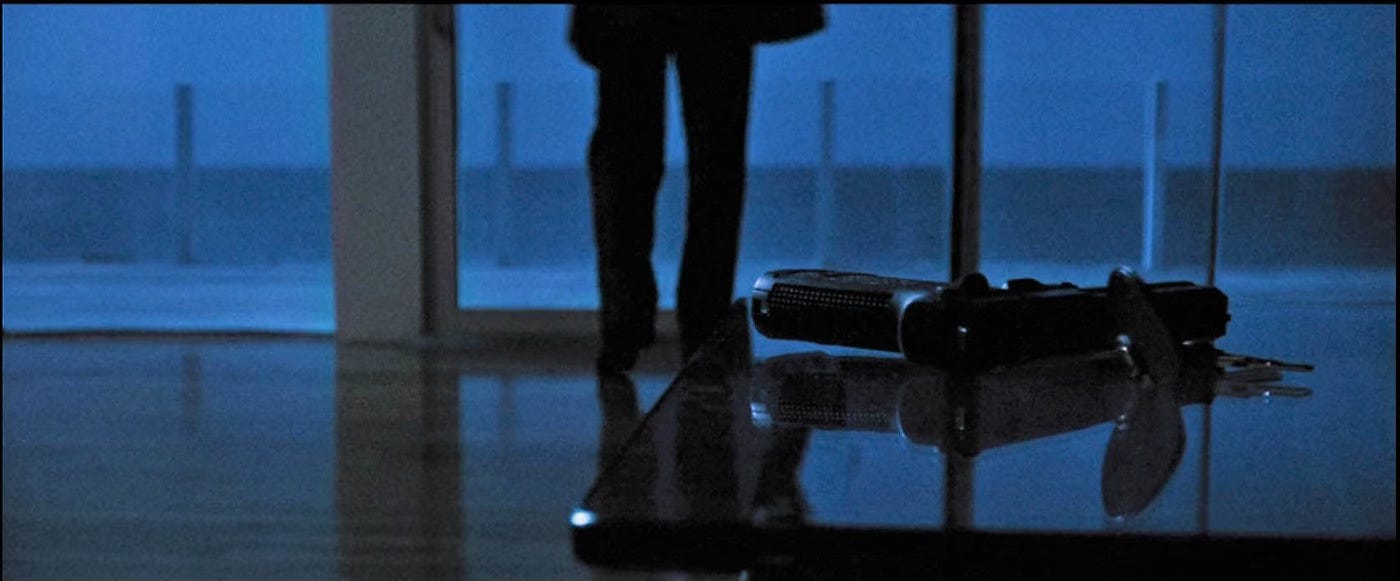
Michael Mann portrays this isolation with cinematic precision. The recurring imagery of characters framed against vast, empty cityscapes or alone in sterile apartments illuminated by blue hues evokes a sense of spiritual desolation. Los Angeles itself becomes a mirror of their condition—simultaneously sprawling and claustrophobic, teeming with life yet devoid of meaningful contact. This visual isolation is reinforced by the sound design: long stretches of ambient noise or silence are punctuated only by dialogue or the distant hum of urban machinery. Mann’s LA is not a romantic metropolis—it is a city of the soul, cold and inescapable.
Neil McCauley’s Isolation: Discipline as Distance
McCauley lives by a strict creed: “Don’t let yourself get attached to anything you are not willing to walk out on in 30 seconds flat if you feel the heat around the corner.” This mantra is not merely a survival strategy—it is a philosophy of life. McCauley believes that attachment breeds vulnerability, and vulnerability leads to ruin. He has replaced emotional connection with control, friendship with efficiency, and intimacy with professional loyalty. His crew respects him, perhaps even loves him, yet McCauley maintains a cool distance. He is the fulcrum of their operation, but not truly a part of it.
This detachment is reflected in his personal life—or rather, his lack of one. His home is a minimalist shell, devoid of personality, colour, or warmth. It is not a sanctuary, but a bunker—a place to rest between missions. He has no family, no real friendships, and no past that we are made aware of. His only genuine attempt at connection comes late in the film when he begins a relationship with Eady, a graphic designer he meets at a bookstore. Initially, he approaches her with caution, even suspicion. However, gradually, he allows a chink in his armour to appear.
Eady becomes a symbol of the life McCauley might have had—the life of quiet domesticity, of belonging. Yet, the tragedy of McCauley is that his creed will not allow for compromise. Even as he opens himself up to love, he remains shackled to the belief that survival requires detachment. When the moment comes to choose, when Waingro reappears and the opportunity for revenge arises, McCauley does not hesitate. He walks away from Eady, not because he doesn’t care, but because he cares too much to risk her life. In a cruel twist, his final act of isolation is a gesture of protection. He sacrifices connection to uphold a code he no longer truly believes in.
Vincent Hanna’s Isolation: Obsession as Identity
Where McCauley is disciplined to the point of sterility, Vincent Hanna is chaos held together by sheer will. He is a man defined not by rules but by compulsion. His pursuit of criminals is not merely professional—it is personal, emotional, almost spiritual. He speaks of the horrors he has witnessed—murdered children, mutilated bodies—not with numbness, but with a barely suppressed rage. This internal fire fuels his brilliance, yet it also consumes everything around him.
Hanna’s personal life is in disarray. His third marriage is disintegrating, his stepdaughter is suicidal, and his home is more a battleground than a refuge. He tries to keep his two worlds separate, but they bleed into one another. His wife, Justine, accuses him of being emotionally unavailable: “You don’t live with me, you live among the remains of dead people.” Hanna doesn’t deny it. He can’t. The job is not merely something he does—it is who he is. Like McCauley, he has sacrificed intimacy for purpose, but whereas McCauley seeks control, Hanna thrives in chaos. It’s what he knows. It’s what he’s good at.
One of the most telling scenes in the film comes when Hanna returns home after an exhausting stakeout to find Justine in bed with another man. He doesn’t lash out, nor does he collapse into rage or heartbreak. Instead, he acknowledges the inevitability of the situation. “All I am is what I’m going after,” he tells her. The tragedy is not that Hanna is betrayed, but that he understands the betrayal as a logical consequence of who he’s become. He has become a stranger in his own home, an observer rather than a participant in his own life.
Two Halves of a Whole
What makes the dynamic between Hanna and McCauley so compelling is that their isolation is not the result of failure, but rather of success. Both men are elite in their respective fields; they are the best, the most disciplined, and the most committed. However, that commitment comes at a cost. The further they ascend in their roles, the more they lose their connection to the world around them. Their greatness is inextricably linked to their loneliness.
In many ways, the diner scene represents the only moment in the film when either man experiences genuine companionship. They converse not as cop and criminal, but as kindred spirits. Their dialogue is devoid of pretence, marked by mutual recognition. It is the sole instance in which either man feels truly seen. Yet, even during this moment of communion, the spectre of violence looms. Both men are aware of how this will end. Both realise they cannot stop. Their understanding of one another is sincere, but it is also futile. They are destined to destroy one another, not out of hatred, but because their roles demand it.
The film’s final act underscores this tragic inevitability. As McCauley attempts to flee with Eady, the dream of a different life flickers into view. For a moment, it seems possible. He could escape, start anew, and break the cycle. However, when he learns of Waingro’s location, he turns back. The code wins. The obsession triumphs. With that choice, McCauley seals his fate.
Hanna, too, is transformed by the pursuit. When he finally kills McCauley at the airport, there is no triumph, only silence. He holds McCauley’s hand as he dies, a gesture of quiet respect. In that moment, the boundary between cop and criminal dissolves. What remains are two men who have given everything to their obsessions—and lost everything in return.
VII. The Final Confrontation and Symbolic Resolution
The climax of Heat is not simply a confrontation between a cop and a criminal; it is a culmination of the film’s central dialectic between order and chaos, discipline and obsession, control and entropy. The final showdown between Vincent Hanna and Neil McCauley at Los Angeles International Airport is imbued with layers of meaning, serving as a symbolic resolution to the themes that have defined the narrative.
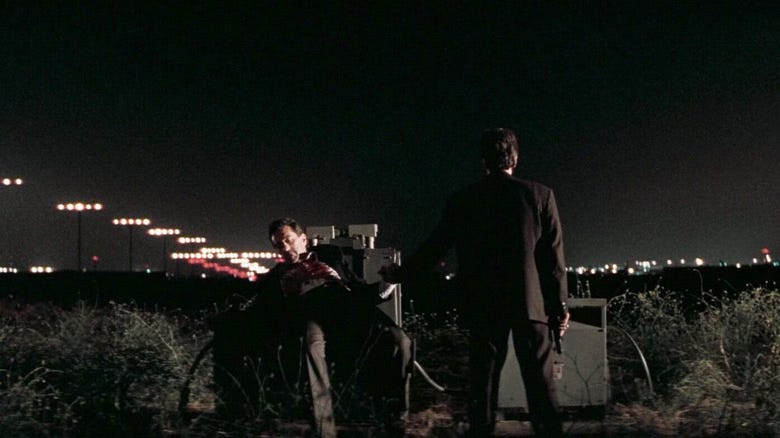
This final encounter is devoid of the grandeur and chaos that characterised the earlier bank heist and shootout. Instead of a sprawling urban battleground, the setting is a sterile, empty airport runway—a liminal space that emphasises the transitional nature of the moment. It serves as a space between worlds, between life and death, between order and disorder. Mann’s choice of this setting is intentional: the airport is a place of departures and arrivals, a site of escape and confrontation, embodying the tension between moving forward and being trapped by the past.
Order in the Form of Cold Calculation
McCauley’s approach to this confrontation is clinical and controlled. After years of living by his code-no attachments, no loose ends—he stands ready to execute a flawless exit strategy. Yet, even here, there is a subtle recognition of his own vulnerability. Throughout the film, McCauley’s character is defined by his unwavering commitment to a principle that equates detachment with survival. However, his final moments reveal cracks in this armour. The choice to confront Hanna one last time is not merely tactical but deeply personal.
The prolonged pause before the fatal shot—McCauley’s moment to choose between flight and fight—transforms into a meditation on fate and consequence. The tension is palpable, intensified by Mann’s signature long takes and deliberate pacing. McCauley’s fatal hesitation unveils the human beneath the machine, the man torn between the demands of his code and the tug of his own mortality. It is the moment when chaos asserts itself against order, where instinct overrides discipline.
Chaos as an Inevitable Force
Hanna, in contrast, embodies the relentless force of law and moral order. Yet his victory is bittersweet. The film’s final moments reveal that the triumph of order is never absolute or celebratory. Hanna’s expression is grim, his exhaustion evident. He has fulfilled his duty, albeit at a tremendous personal cost. His victory over McCauley does not restore balance to the world; it only perpetuates the cycle of loss and alienation that defines his existence.
Their final exchange is haunting in its simplicity. Hanna’s gesture of holding McCauley’s hand as he dies transcends the boundaries of cop and criminal. It acknowledges their shared humanity and the loneliness that binds them. This moment is not just the conclusion of a rivalry; it is a tacit recognition that both men are ensnared in roles defined by forces larger than themselves—forces of law, crime, order, and chaos.
The Airport as a Symbolic Battleground
The airport setting underscores the film’s exploration of liminality. It is neither home nor foreign land, neither safety nor danger. It serves as a place of transition, filled with possibilities and impossibilities. McCauley’s plan to escape to a new life is symbolically represented by the airplane, a vehicle capable of transcending boundaries and rewriting one’s destiny. Yet, the presence of Hanna at this threshold signifies the impossibility of escaping one’s past and nature.
The final scene thus becomes a metaphor for the human condition as portrayed in Heat: the eternal struggle between control and surrender, between the desire to impose order and the inevitability of chaos. Neither man wins in a traditional sense. McCauley dies, yet his philosophy of discipline and detachment leaves a lasting impression. Hanna survives, but carries the burden of his obsession and loss. Their fates mirror the cyclical nature of their conflict—order suppresses chaos temporarily, yet the tension between the two is perpetual.
Narrative and Thematic Closure
Heat concludes not with resolution but with ambivalence. The characters are ensnared within the systems they represent—Hanna within the law enforcement apparatus, McCauley within the criminal underworld. Both men are ultimately isolated by their commitment to order and chaos, respectively, their personal sacrifices highlighting the tragic cost of their obsessions.
This ambiguity testifies to Mann’s refusal to simplify the moral landscape. Heat neither glorifies crime nor idealises law enforcement. Instead, it presents a nuanced meditation on human duality, the coexistence of order and chaos within individuals and societies. Hanna and McCauley’s relationship—marked by mutual respect, parallel lives, and inevitable conflict—embodies this duality. They are mirror images, each defining himself in opposition to the other, yet inseparable in their shared fate.
The film’s closing shots linger on Hanna as he gazes at the departing plane, encapsulating the unresolved tension. There is no triumphant return, no final peace. Instead, there is a solemn acknowledgement of the cost of their choices and the enduring nature of the struggle they represent.
Conclusion
In Heat, Michael Mann creates a cinematic exploration of duality through the intricate relationship between Vincent Hanna and Neil McCauley. Their lives exemplify the conflict between order and chaos, discipline and obsession, connection and isolation. Through meticulous characterisation, narrative structure, and innovative cinematic techniques, the film delves deeply into the human condition, depicting two men intertwined by fate and philosophy yet separated by the roles they occupy.
The film’s enduring power resides in its refusal to provide easy answers. Rather, it depicts a world in which order and chaos are intertwined forces that shape identity, morality, and destiny. Through Hanna and McCauley, Heat serves as a meditation on the costs of adhering to strict codes within a realm dominated by unpredictability and disorder.
⸻
Bibliography
Bordwell, David. The Cinema of Michael Mann: Style, Substance, and Sensation. University of California Press, 2002.
Dancyger, Ken. The Technique of Film and Video Editing: History, Theory, and Practice. Focal Press, 2010.
Grant, Barry Keith. Film Genre: From Iconography to Ideology. Wallflower Press, 2007.
Hansen, Miriam Bratu. Babel and Babylon: Spectatorship in American Silent Film. Harvard University Press, 1991.
King, Geoff. New Hollywood Cinema: An Introduction. Columbia University Press, 2002.
Mann, Michael, director. Heat. Warner Bros., 1995.
Monaco, James. How to Read a Film: Movies, Media, and Beyond. Oxford University Press, 2000.
Prince, Stephen. The Warrior’s Camera: The Cinema of Akira Kurosawa. Princeton University Press, 1991.
Sobchack, Vivian. The Address of the Eye: A Phenomenology of Film Experience. Princeton University Press, 1992.
Thompson, Kristin, and David Bordwell. Film History: An Introduction. McGraw-Hill, 2010.