The Searchers
In What Ways Does Ethan Edwards Embody Both Heroism and Monstrosity in The Searchers?

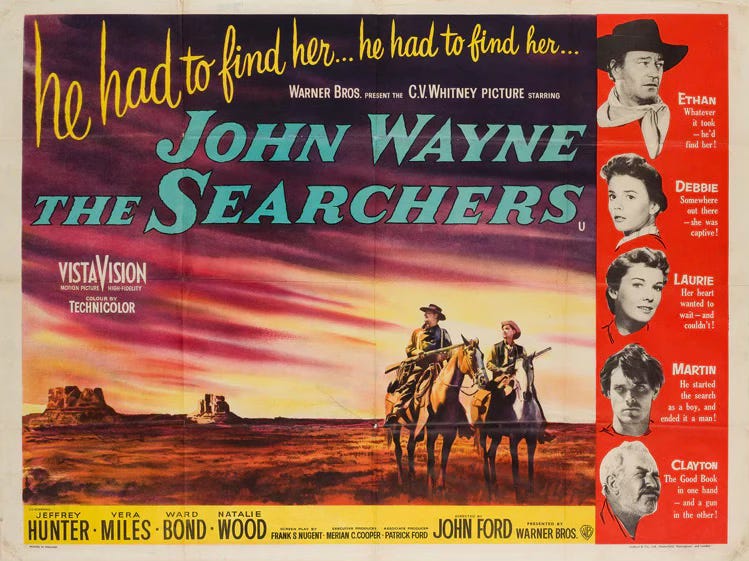
The Man Who Came Back Wrong
John Ford’s The Searchers (1956) is widely regarded as one of the greatest American films ever made, not only for its visual grandeur or influence on the Western genre, but also for the profound moral and psychological ambiguity at its centre. At the core of the film is Ethan Edwards, played by John Wayne in a role that radically redefines his screen persona. Ethan appears to be the film’s hero—a Civil War veteran who undertakes a years-long quest to rescue his kidnapped niece Debbie from a Comanche tribe. However, as the film unfolds, Ethan’s actions, motives, and emotional states reveal a man shaped just as much by hatred as by honour, by prejudice as much as by principle. He becomes a liminal figure, a frontier hero and a potential executioner. Ford’s film, and Ethan in particular, prompts a reassessment of the mythic American hero by contrasting acts of bravery with the moral monstrosity of racism, vengeance, and spiritual exile.
This essay will explore the duality of Ethan Edwards, depicting him as both hero and monster. It will do so by analysing how his character challenges traditional Western stereotypes, how racial ideology corrupts his sense of justice, and how his personal trauma drives an obsessive quest that risks slipping into genocidal violence. It will also consider the film’s ambiguous ending and how Ford ultimately refuses to provide a straightforward moral resolution. In Ethan, we see not the shining exemplar of American idealism, but a fractured monument—haunted, haunting, and human.
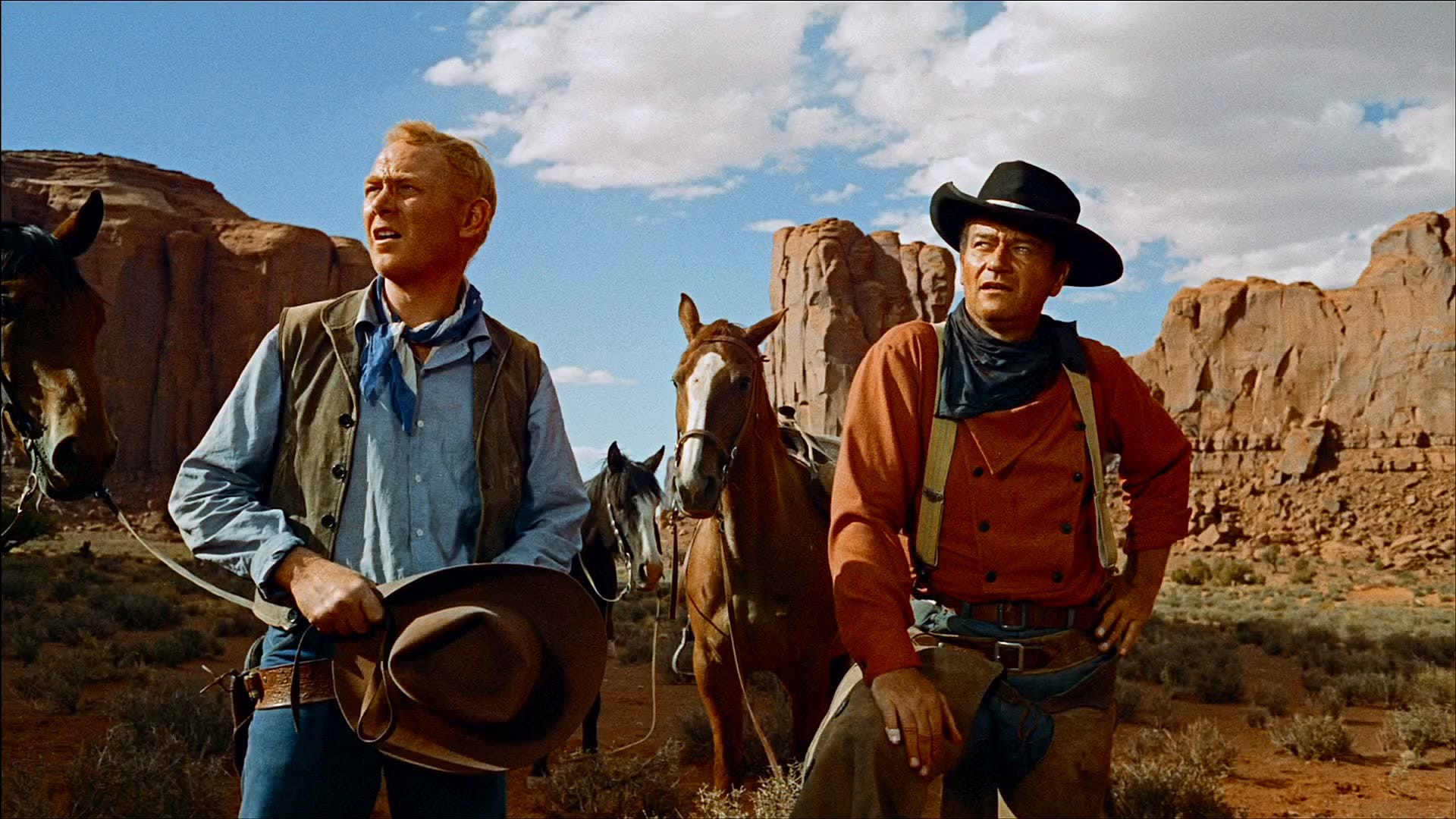
The Classical Western Hero Deconstructed
To appreciate Ethan’s moral ambiguity, one must first understand the archetype he challenges. The traditional Western hero—embodied by actors like Gary Cooper, Randolph Scott, and earlier portrayals of John Wayne—is a figure of stoic honour, whose rugged individualism is tempered by a code of justice and the defence of community. Such heroes often operate outside the law but remain guardians of civilisation. They tame the frontier through grit and virtue.
Ethan Edwards seems to fit this mould on the surface. He is a former soldier, a skilled tracker, and a man of action unafraid of violence. His pursuit of Debbie spans years, harsh landscapes, and personal sacrifice. Yet from his very first scene, Ford indicates that Ethan is no simple knight-errant. He arrives at his brother’s homestead from an obscured past. He refuses to take the oath of allegiance to the Union, and when asked where he’s been, he avoids the question. These small but significant narrative details suggest that Ethan is not merely a man returning home—he is a man estranged from the very nation he once fought for. He is an outsider cloaked in the trappings of a hero, but his loyalties and identity are unstable, fractured.
This concept of the “outsider within” is essential to understanding Ethan’s moral duality. Although accepted by his brother’s family, he remains separate, never fully part of domestic life. He does not sit comfortably within the community; his energy is restless, and his presence too volatile. He is neither a lawman nor a settler; he is a wanderer shaped by displacement and trauma. In this way, Ethan exemplifies the darker side of the Western hero: the man who lives through violence and is unable to adapt to peace.
Ford’s direction and Wayne’s performance work together to make Ethan both mythic and unsettling. His silhouette, often set against vast horizons, suggests monumental grandeur — but he is also frequently depicted in harsh light, grimacing, with shadowed eyes hiding more than they show. His charisma is undeniable, yet his humanity is always in doubt. We admire his resolve while also fearing its consequences.
Obsession and Purpose: The Thin Line Between Devotion and Mania
At the heart of The Searchers lies a seemingly straightforward story engine: a rescue mission. When Comanche warriors attack the Edwards homestead, killing Ethan’s brother and sister-in-law and kidnapping their two daughters, Ethan teams up with young Martin Pawley to bring Debbie back home. However, the journey swiftly evolves beyond mere search—it becomes a moral test revealing Ethan’s true character.
Most heroic journeys are driven by love, duty, or principle. Ethan’s, by contrast, is propelled by a complex and disturbing mix of vengeance, racism, and personal obsession. Early on, he kills buffalo en masse not for food or defence, but to deny the Comanche sustenance—a petty act of cruelty dressed up as strategy. He desecrates a Comanche corpse by shooting out its eyes so the soul “wanders forever between the winds.” These actions, meant to demonstrate resolve, instead suggest spiritual sickness.
As the years pass, Ethan’s determination becomes obsessive. He persists in his search even when others give up. While such tenacity might be seen as heroic in other stories, here it is portrayed as isolating and fanatical. He refuses the chance of reintegration into society, severing all ties to community, romantic love, or stable life. Ethan becomes a man defined entirely by the quest, more force than individual. His single-mindedness echoes that of Captain Ahab in Moby-Dick: the hunter consumed by the hunt.
Martin Pawley, Debbie’s part-Cherokee adopted brother, acts as Ethan’s moral opposite. While Ethan is driven by blood and vengeance, Martin is motivated by compassion and family loyalty. Their relationship presents the audience with a moral contrast, making us question not only what Ethan is doing but also why.
This question reaches a horrifying climax when Ethan reveals that, should Debbie have become the Comanche chief Scar’s “squaw,” he intends not to rescue her, but to kill her. His reasoning is stark: she would be “tainted,” no longer white, and therefore no longer redeemable. In this moment, Ethan crosses the line from obsessive protector to potential murderer. The rescue becomes an act of racial purification. He would rather see his niece dead than assimilated into another culture. This is not heroism—it is a doctrine of extermination.
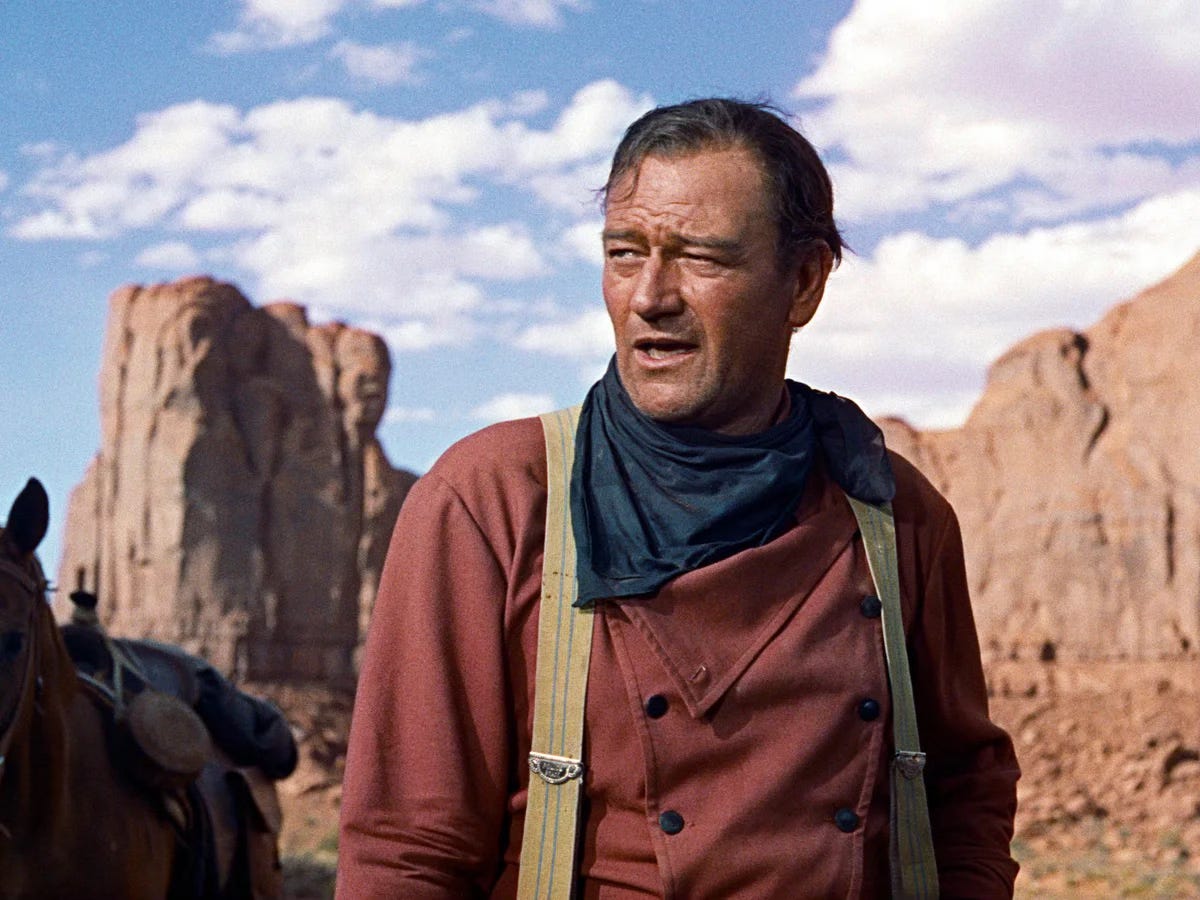
Racial Hatred as Moral Rot
Ethan’s racial ideology is the darkest aspect of his character, and it is the primary source of his monstrosity. His hatred of Native Americans is not merely cultural or strategic—it is existential. He does not see them as enemies to be negotiated with or defeated, but as fundamentally subhuman. This belief system shapes his every action and transforms his pursuit of Debbie from a noble cause into a form of ethnic cleansing.
Ford does not shy away from this discomforting reality. In one of the film’s most infamous scenes, Ethan and Martin discover a white woman rescued from Comanche captivity. She is catatonic, traumatised, her identity seemingly dissolved. Ethan stares at her with visible disgust, declaring she is “not even white anymore.” His reaction is not empathetic—it is revulsion, as though racial identity were something that could be stained and discarded. His racism is not a byproduct of conflict—it is the core of his worldview.
The central antagonist of the film, Scar, is a Comanche chief whose own sons were killed by white men. Ford gives Scar a moment of tragic agency: “You are the father of many sons, I am the father of two. They were killed by white men.” This line, delivered calmly, humanises Scar in a way that Ethan never affords Native Americans. Scar is no mere savage—he is a leader shaped by grief, much like Ethan. Both men are motivated by vengeance. Both are willing to sacrifice children to satisfy blood debts. In this mirroring, Ford reveals the true horror: Ethan and Scar are not opposites—they are doubles.
Ethan’s racism is not merely a character flaw; it is a systemic monstrosity that corrupts his sense of justice and makes his love conditional. His failure to see Debbie as fully human after she has lived among the Comanche is an indictment of a society that links race with purity and belonging. In Ethan, Ford dramatises the psychosis of American racism—a psychosis cloaked in the guise of heroism.
The Ambiguous Redemption: What Ethan Does, and What He Doesn’t
And yet, Ethan does not kill Debbie. In the film’s climactic scene, he lifts her into his arms and softly says, “Let’s go home, Debbie.” It is perhaps the most emotionally charged line in Ford’s entire body of work. After years of dehumanisation, Ethan chooses mercy. But this moment is not redemptive in the traditional sense. It is too quiet, too restrained, too unresolved. It feels less like a transformation and more like a flicker of humanity breaking through years of hatred.
Why does Ethan spare her? The film never says. It could be that Martin’s moral example has slowly eroded Ethan’s fanaticism. It could be that the sheer futility of his mission has finally exhausted him. Or perhaps, in Debbie’s eyes, he sees a glimmer of his lost family—a thread that reconnects him to the man he used to be before war and ideology consumed him.
Regardless, Ethan’s act of mercy does not absolve him. He does not return to the community. In the film’s iconic final shot, Ethan stands in the doorway of the homestead as the family moves inside. He watches them from a distance. Then he turns and walks away—back into the wilderness, alone. Ford frames him in silhouette, cut off from warmth and domesticity. The door closes on him.
This ending is vital. It resists the temptation to tidy Ethan’s arc into redemption. He may have done the right thing in the end, but he remains fundamentally unfit for the world of love, peace, and community. The years have hollowed him. He cannot cross the threshold. He is a relic—honoured perhaps, but exiled all the same.
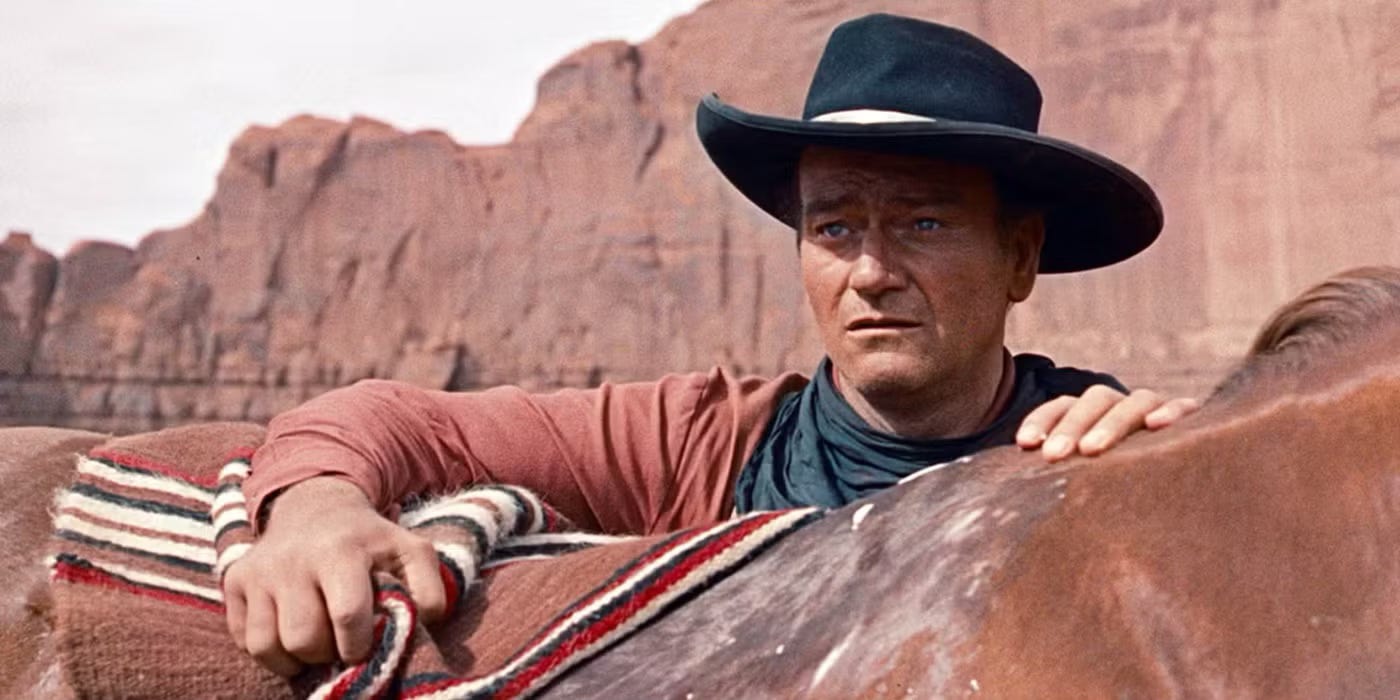
Myth and Revisionism: Ford’s Final Verdict
The Searchers holds a special place in the Western canon because it stands at the intersection of myth and revisionism. On one hand, it presents stunning Monument Valley landscapes, sweeping orchestral music, and archetypal conflicts. On the other hand, it carefully deconstructs its own genre conventions. It features a hero whose moral authority is questionable, whose motives are corrupted, and whose ending is not triumphant but tragic.
Ford, often regarded as a conservative filmmaker, is surprisingly radical in his portrayal of Ethan. He uses John Wayne—the very icon of American masculinity—as a vessel to explore the costs of heroism. He asks: What happens when a man is built entirely by violence? What remains of him when peace is restored? Can a man so twisted by hatred still do good? And if so, does that make him a hero—or just a slightly less harmful monster?
In Ethan, we see the American frontier myth unravelling in real time. He embodies Manifest Destiny’s dark side: the belief that civilisation justifies atrocity, that whiteness equals worth, and that some lives are not worth saving. Yet he is also capable of tenderness, sacrifice, and restraint. He is not easily categorised. He demands that we live with contradiction.
The Man Outside the Door
Ethan Edwards is a paradox carved in granite. He is both a figure of admiration and revulsion, a man whose endurance and courage are matched only by his prejudice and rage. In The Searchers, John Ford creates a meditation on American identity, one that rejects comfort or simplicity. Ethan is not a straightforward hero. He is the shadow that follows the hero—the cost of conquest, the ghost of war, the scar of ideology.
His monstrosity lies not only in his violence but also in the reasons behind it: the belief that only some people are worth saving, that purity can be restored through death, and that identity is destiny. His heroism, if it can be called that, lies in his final decision not to act on these beliefs. But it is too little, too late. He cannot rejoin the world he has helped to preserve. He must walk away.
Ethan's final image—framed in a doorway he cannot cross—is more than a cinematic flourish. It serves as a moral judgment. The West may have been won, but not by men like Ethan. It was achieved despite them. And the film, like that door, closes on his legend—not to deny it, but to contain it.
⸻
Bibliography:
Ford, John, director. The Searchers. Warner Bros., 1956.
Ebert, Roger. “The Searchers.” RogerEbert.com. Last modified January 1, 2001. https://www.rogerebert.com/reviews/great-movie-the-searchers-1956.
Kitses, Jim. Horizons West: Directing the Western from John Ford to Clint Eastwood. London: British Film Institute, 2004.
Slotkin, Richard. Gunfighter Nation: The Myth of the Frontier in Twentieth-Century America. New York: HarperPerennial, 1992.
Mulvey, Laura. “Visual Pleasure and Narrative Cinema.” Screen 16, no. 3 (Autumn 1975): 6–18.
Buscombe, Edward. The Searchers. London: BFI Publishing, 2000.
Cawelti, John G. The Six-Gun Mystique Sequel. Bowling Green, OH: Bowling Green State University Popular Press, 1999.
Wright, Will. Sixguns and Society: A Structural Study of the Western. Berkeley: University of California Press, 1975.
Stanfield, Peter. Hollywood, Westerns and the 1930s: The Lost Trail. Exeter: University of Exeter Press, 2001.